
Smart Ideas for Modern Technology
A Flame Sensor-based Fire Detection System is one of those projects. It’s simple, affordable, and could quite literally be a lifesaver.
Unlike a smoke detector, which waits for particles to reach it, a flame sensor is much faster. It looks for Infrared (IR) light emitted by fire. Specifically, most flame sensors are tuned to detect light in the wavelength range of 760nm to 1100nm.
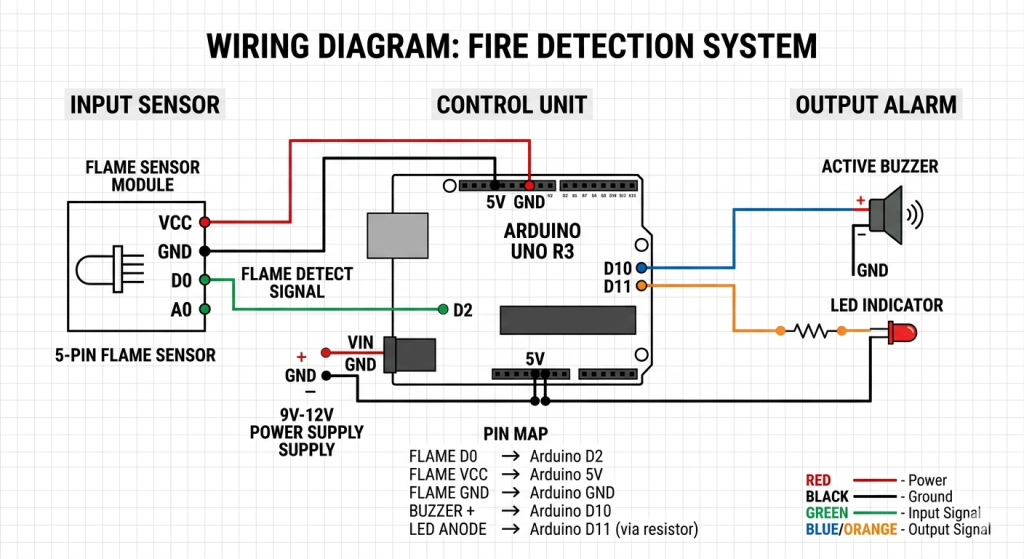
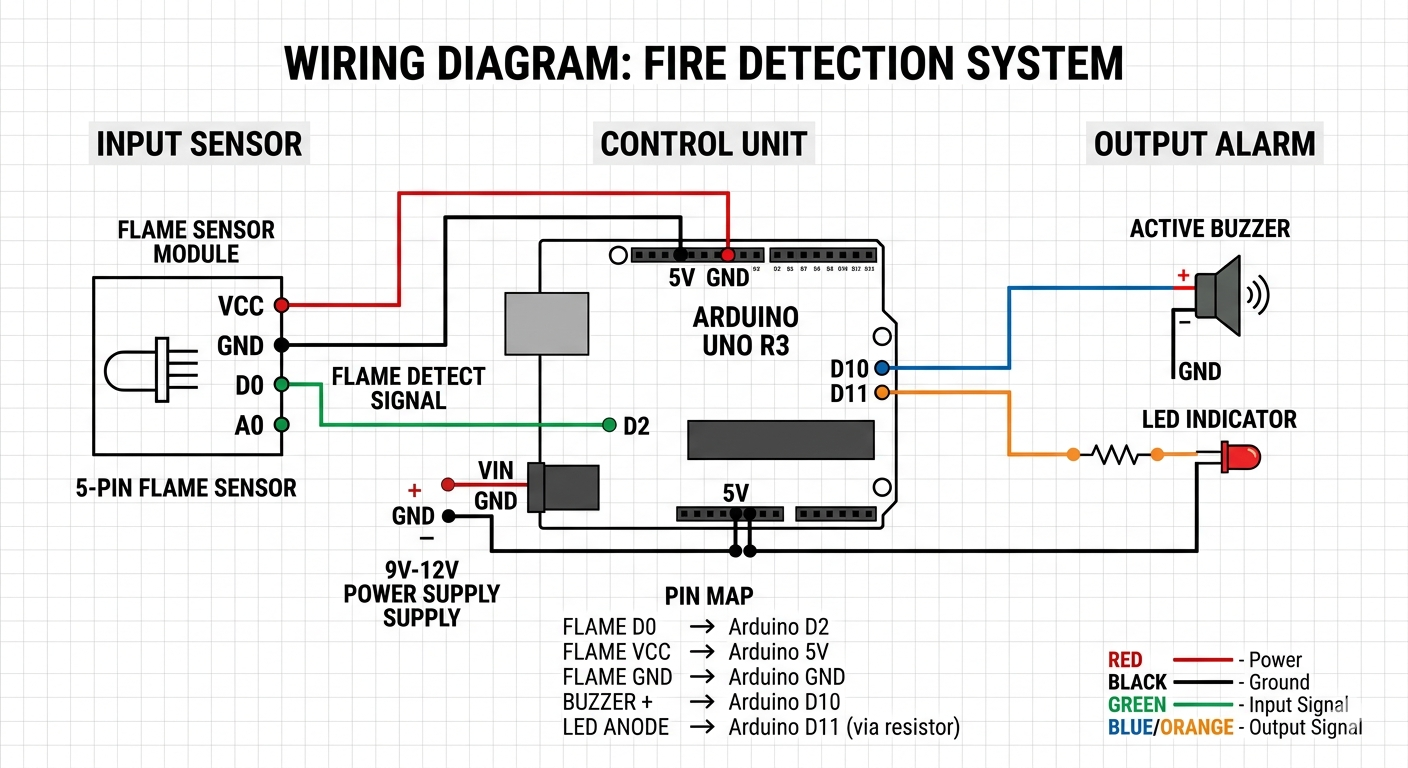
Arduino Uno (or any microcontroller) The “brain” of the operation.
Flame Sensor Module The “eyes.”
Buzzer To give you a loud, audible warning.
LED (Red) For a visual “Fire” indicator.
Jumper Wires & Breadboard To bring the family together.
When we code this, we aren’t just writing lines of text; we are giving the machine a set of “instincts.”
The Watch: The sensor constantly monitors the IR levels in the room.
The Threshold: We use the small knob (potentiometer) on the sensor to set a “danger zone.” This ensures the alarm doesn’t go off just because the sun is shining through the window.
The Reaction: If the IR levels cross that danger zone, the Arduino triggers the buzzer and LED instantly.
While professional systems exist, building your own gives you a deeper understanding of safety technology. It’s a perfect project for
Smart Home Prototypes: Integrating it with a Wi-Fi module (like the ESP8266) to send a notification to your phone.
Industrial Models: Learning how sensors are used in factories to protect expensive machinery.
Student Science Fair Projects: It’s a classic because it’s impactful and easy to demonstrate.
Electronic projects are fun, but fire is serious. Always remember that DIY sensors are great for learning and supplementary alerts, but they should never replace certified, professional smoke and fire alarms required by law in your home.
Building a fire detection system reminds us that technology is at its best when it’s looking out for us. It’s a simple circuit, but the logic behind it Detection, Analysis, and Action is the foundation of all modern safety systems.
Contact us